

Meet Chrissy. She’s a 4th grader who can name every player on her soccer team and who stays after practice to work on corner kicks until the light runs out. She misses, laughs, adjusts her angle, and tries again.
In reading group, she’s a different child. She knows her letter sounds. She passes her phonics checks. But when it’s her turn to read aloud, her voice drops, her finger stalls under each word, and her eyes drift to the clock.
On the field, Chrissy is an active learner. In reading, she’s waiting it out.
Does Chrissy sound familiar? If you’ve met students like her, you’re not alone. Forty-three states have now adopted Science of Reading legislation, and that is real progress. Yet it’s estimated that up to 50% of U.S. students still lack the foundational reading skills they need to become fluent readers. In a class of 24, that could be 12 children who can sound out words but can’t yet read them automatically.
Chrissy isn’t short on effort. We just haven’t given her the right practice at the right time for her to be successful.
Reading Is Learning
The Science of Reading has given us a clear picture of what children need to learn. The Science of Learning tells us how to make it stick. For 60 years, researchers have studied how people build complex, automatic skills: how a pianist’s fingers find the chords or how a toddler learns to talk. Reading follows that same path, from effortful to effortless.
I want to emphasize how important engagement and inclusion are for fostering learning. Unfortunately, we often focus on what must be taught rather than how each child can engage and participate as a successful learner. Chrissy isn’t a reading problem to be solved. She’s a learner. And so is every one of her classmates.
What Does an Active Learner Look Like?
Active learning is a function of the environment. Watch Chrissy at soccer practice, and you’ll see every quality of an active learner:
- Engaged. She’s in the work, not watching it.
- Curious. She wants to know why the ball curved left.
- Self-motivated. No one has to ask her to stay late.
- Resilient. She makes mistakes and treats them as information.
- Flexible. She adjusts when a defender shifts position.
- Successful and confident. She’s had enough wins to believe the next one is possible.
- Loves to practice. And because her practice works, she keeps coming back.
What strikes me about Chrissy is that she already knows how to be an active learner in the right environment. She just hasn’t had the chance to be one in reading. That isn’t a flaw in Chrissy. It’s a matter of learning conditions, and conditions are something we can change, together.
Why Principles Matter
A principle is a pattern that holds no matter the skill. All automatic, complex skills—serving a tennis ball, playing a scale, recognizing a word—develop through the use of the same effective learning principles. That’s why they apply at every stage of reading, from phonemic awareness to automatic word recognition, the gateway skill to fluency and comprehension.
It’s also why practice deserves as much care as instruction. You show your students what to learn. Practice is where students make it their own, and that’s why the conditions for practice are so critical. And practice is much more than repetition. Drilling the same word list until it’s “mastered” isn’t the same as building knowledge and skills a child can call up instantly, anywhere, for years to come.
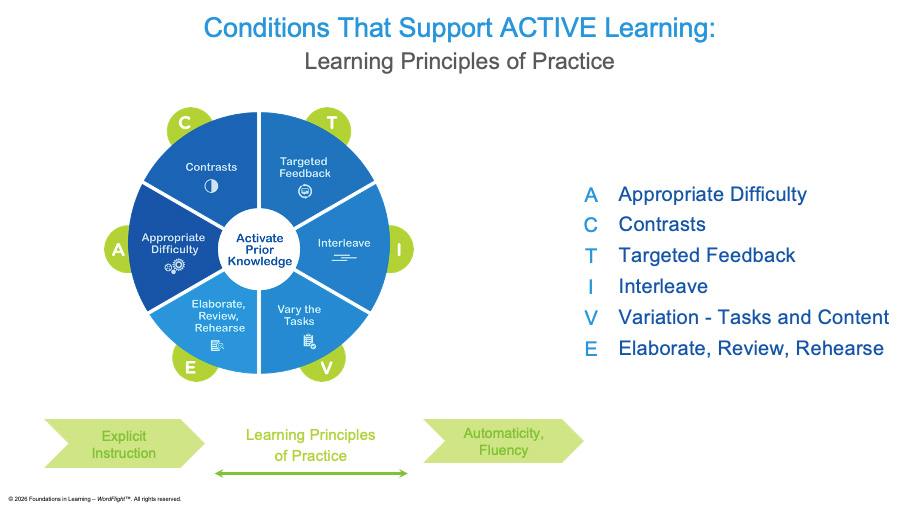
The ACTIVE Learner: Learning Principles of Practice Needed to Drive the 5 Pillars
Principles of Practice that Support ACTIVE Learning
At the center of the ACTIVE framework is activating prior knowledge: every new pattern connects to something the learner already knows. Six principles sit around it. Here’s what each one looks like for Chrissy.
A — Appropriate difficulty. Learning sticks when practice takes effort without overwhelming the student. Cognitive scientists call these desirable difficulties—challenges that strengthen memory because the brain has to work. When Chrissy reads ‘long-a’ words quickly and accurately, her practice moves to a new pattern. When errors climb, it eases back. The target moves with her.
C — Contrasts. Readers grow efficient by noticing what makes words different. Practicing hop and hope or bat and bait side by side teaches Chrissy to notice the patterns that change the pronunciation. And comparing makes those memories last.
T — Targeted feedback. If Chrissy reads chain as chin, she needs to know right then, with a cue that points her to the ai—not three days later on a worksheet. Immediate feedback turns an error into information, keeps difficulty in a productive range, and keeps her engaged because she experiences success.
I — Interleave. Instead of all the ai words on Monday and all the ea words on Tuesday, interleaving mixes patterns in a single session. When rain, seat, and cake appear together, Chrissy has to stop and notice which pattern she’s looking at. It’s harder. Usefully so. And it helps her transfer what she knows to new words.
V — Vary the tasks. Chrissy should meet the same pattern in many ways: hearing a word and choosing its spelling, building it from parts, finding it in a sentence. Variation makes the regularities “pop.” Apfelbaum, McMurray, and Hazeltine (2013) found that first graders at both higher and lower performance levels learned vowel patterns better with high-variability practice and carried that learning to words they’d never seen.
E — Elaborate, review, rehearse. Skills fade without return visits. Revisiting a pattern from three weeks ago, or noticing that act, action, and actor share a root, strengthens memory and moves Chrissy toward automaticity. Review isn’t a step backward. It’s how learning settles in.
Applying all six principles, for every student, every day, is a lot to ask of one teacher with 24 or more children in class. I know how hard you’re already working.
Putting the Principles to Work
That’s why my co-founder and research partner, Jerry Zimmermann, and I built WordFlight around these principles. Our Varied Practice Model weaves contrasts, interleaving, task variation, productive difficulty, and review into a game-like environment that adapts to each student and offers immediate feedback. It supports your teaching rather than replacing it.
And it works. With 60–80 minutes of use per week, WordFlight moves 75% of struggling middle school students to automaticity in foundational reading skills in one school year, with 100% reaching automaticity within two years. For those students, it means opening a science chapter without dread and walking into high school as readers.
Back to Chrissy
Picture Chrissy a few months from now. Her practice fits her, so she succeeds more often than not. Her mistakes are caught in the moment, before they harden into habits. And slowly, the girl from the soccer field starts showing up in reading group. She volunteers. She tries the hard word. She asks for one more round. She wants to take turns reading aloud at home.
This is an active learner, not a personality type. This is the result of the right practice at the right time.
My mother believed all children can learn to read. I still do. When we design practice around how learning really works, we give children more than skills. We give them dignity and opportunity.
What does active learning look like in your classroom? Which of these principles have you seen light up a reader? I’d love to hear from you.