
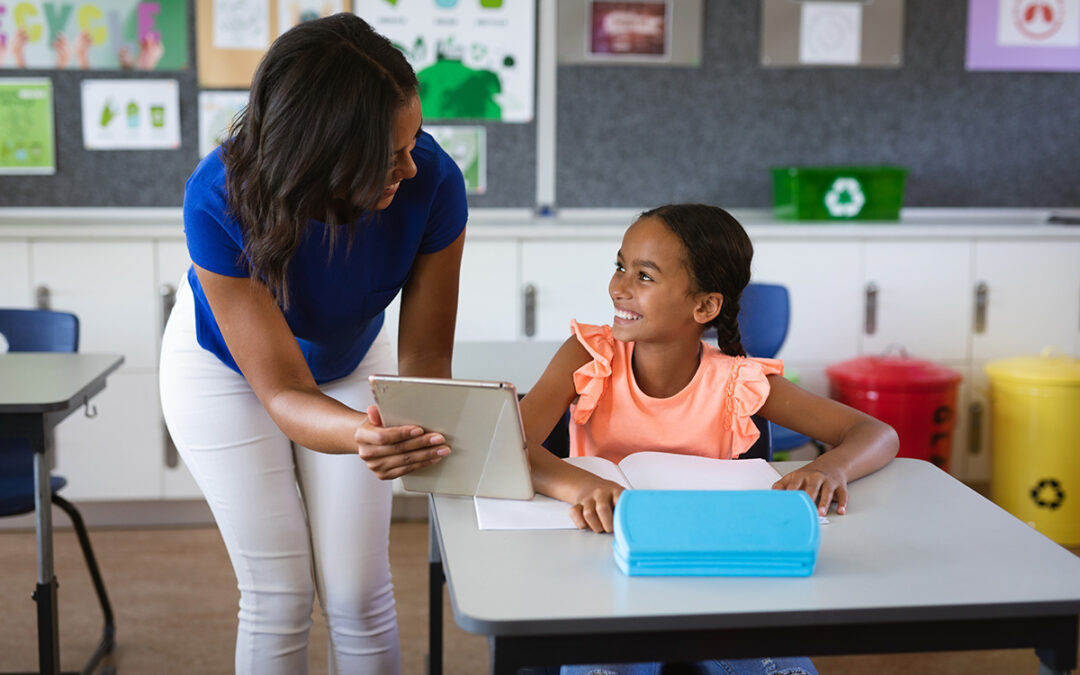
Sofia is a second-grader who lights up during her 20 minutes of reading practice on a tablet at school. She does carefully sequenced tasks that shift and adjust as she works. Her teacher monitors her progress as Sofia builds confidence in her literacy skills through targeted practice.
How is her school screen time different from what she does at home?
Parents and educators have good reason to be concerned about how much time children spend in front of screens. We hear constantly about the effects of endless scrolling and passive entertainment, and the instinct to limit screen time makes sense.
But there’s an important distinction that gets lost in these conversations.
Not all screen time is the same.
A child spending 20 minutes watching short videos is doing something very different from a child spending 20 minutes in carefully designed reading practice that adapts to her learning needs. For students who struggle with reading, this distinction matters.
The Problem Isn’t Screen Time
Learning to read fluently takes more than good instruction. It takes practice—practice intentionally designed to build fluency, comprehension, and the confidence to do more. Becoming fluent requires automatic word recognition, which is challenging for many students. Rather than devoting their cognitive energy to understanding what they read, they instead laboriously struggle to identify each word.
Some students who arrive at school with rich language and literacy experiences readily recognize, retain, and generalize the decoding patterns taught in early reading instruction. This leads to automatic word recognition and supports fluent reading. Others need carefully structured daily practice opportunities to help learning become durable, flexible, and automatic.
Here’s the hard truth: providing that level of individualized practice is extraordinarily difficult, even for our most skilled teachers. Every classroom holds students with different strengths, different paces, and different needs, and one teacher, thirty students, and forty-five minutes were never going to be enough on their own.
What Makes Educational Technology Impactful?
This is where I think the conversation about screen time misses something important.
Technology has the potential to do something that would otherwise be nearly impossible: personalize practice for every learner.
When practice is built on well-established learning principles within a structured curriculum, technology can continually adjust the difficulty of a task, provide immediate feedback, bring back previously learned material at just the right time, and create the kind of varied practice that decades of research tell us strengthens long-term memory and automatic retrieval. This is what the science of learning teaches us: distributed practice, variability, productive challenge, and immediate feedback are the conditions that move new knowledge into flexible, efficient skills.
In other words, technology grounded in learning science isn’t simply digital instruction. It’s a tool for building the best conditions for practice and learning; conditions that would take a teacher hours to construct individually for every single child, every single day.
Technology Extends the Reach of Great Teaching, Not Replace It
I want to be clear about something, because I don’t want this to be misread as an argument against teachers. It isn’t. It’s the opposite.
None of this suggests that technology replaces excellent teaching. Teachers provide instruction, motivation, relationships, and judgment. These are the human elements of learning that no software can replicate. But teachers also face enormous demands. Delivering truly individualized practice to every struggling reader every day is simply beyond what any one teacher can provide without additional support.
Technology is most valuable when it extends the reach of great teaching rather than attempting to replace it.
This is why WordFlight was developed to build the best conditions for learning. Rather than offering passive activities or repetitive drill, WordFlight uses evidence-based practice principles drawn from reading science, cognitive psychology, neuroscience, and learning science. The program continuously adapts to each student’s performance, providing varied learning experiences, immediate feedback, and opportunities to strengthen automatic word recognition and fluency.
As foundational reading skills become more automatic, students can devote more attention to understanding what they read. This is the ultimate goal of literacy instruction.
Looking Beyond “Screen Time”
So perhaps the better question isn’t, “How much screen time did my student have today?”
Instead, we should ask, “What was that screen time helping my student learn?”
If technology is used to support personalized, evidence-based practice that helps a striving reader become more flexible, fluent, and confident, it serves a very different purpose than passive entertainment — even if it looks the same from across the room.
When we treat all screen time as identical, we risk limiting access to one of the most powerful tools for providing the individualized practice many students need to become successful readers.
The conversation should not simply be about reducing screen time. It should be about ensuring that the time students spend with technology is meaningful, scientifically grounded, and focused on helping every child become a skilled, confident reader and thinker.